Rupert Neve Designs MBC Dual-path A/D Converter & Limiter
- 24 Bit / 192 kHz converter
- Analog limiter section with class A line amplifier stage up to 20 dB
- Controllable threshold and release
- Analog inputs: 2x XLR
Rupert Neve Designs MBC Review
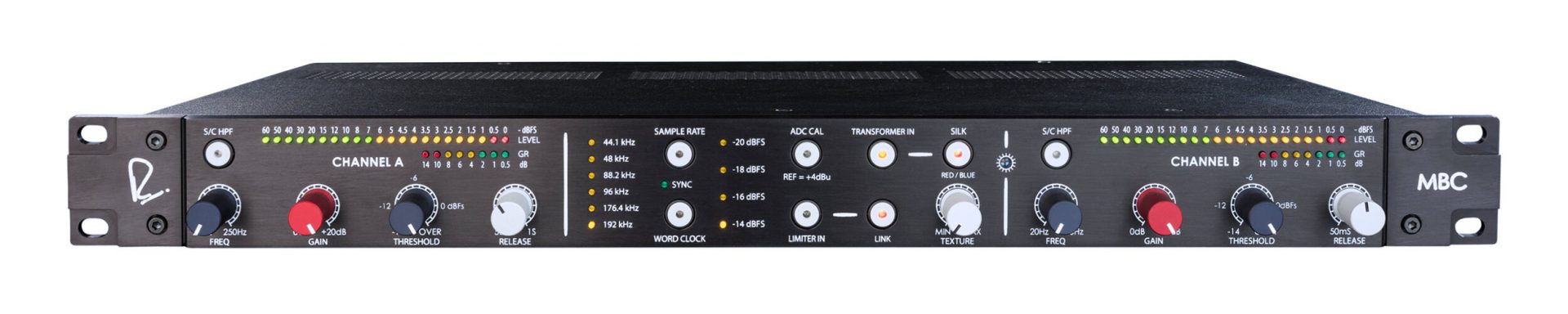
The 1U MBC features two TLA (Transformer-Like Amplifier) line-stage XLR analog input channels, labeled A and B. Each channel has its own set of controls and metering options. A 22-segment LED meter shows the analog input level feeding into the AKM AK5397EQ A/D converter chip.
These meters range from -60dBFS to 0dBFS, and their wide dynamic range is especially useful for spotting low-level stereo bus noise and hum you might not hear at normal listening levels.
Just below the main meters, you’ll find individual eight-LED gain reduction meters for each channel, covering a range of 14 to 0.5dB when the limiter is active. On the rear panel, a pair of small switches lets you set the meter’s hold time (1 or 3 seconds), while a recessed trim pot on the front panel adjusts the overall brightness of the meters.
All front panel control pots are 31-detent models made by Alps or Noble, and we liked how they feel—perfect for matching settings by touch or by counting detents.
Each channel includes a single, continuously variable knob for the limiter’s side-chain high-pass filter, which is a 20Hz to 250Hz 12dB/octave Bessel filter. At the 12 o’clock position, the filter is at -3dB at 125Hz. This filter is highly effective on full mixes and is a key part of the MBC’s sound.
When you insert an HPF in the limiter’s side-chain, low-frequency peaks are less likely to cause unwanted gain reduction—an important feature for today’s bass-heavy pop music. An S/C HPF on/off push button lights up to indicate when the HPF is engaged.
All push buttons on the MBC have LED-lit centers when active, and all switches operate sealed Panasonic miniature relays inside the unit. No audio signals pass through switch contacts, which means you won’t have problems with dirty or intermittent connections over time.
The Gain control ranges from 0dB to +20dB in 0.75dB steps. Use Gain to boost the input signal (if needed) until it hits the limiter’s Threshold setting. It also determines the level sent to the transformer/Silk circuitry (if activated) and then to the A/D converter. Gain works as make-up gain and is only active when the limiter is on. If you raise the Gain knob and/or the input signal exceeds the Threshold, limiting kicks in at a fixed 10:1 ratio.
The Threshold control ranges from -14dBFS (fully counterclockwise), -6dBFS at 12 o’clock, and 0dBFS at 3 o’clock. Full clockwise is labeled OVER, which keeps Gain and the limiter in the circuit but disables limiting—a smart way to keep them ready to use. We always start with the Threshold fully clockwise.
The Limiter uses a pair of THAT Corp 2181A VCA chips and ends with the Release time control, which is adjustable from 50ms to 1 second. Attack time is fixed at 0.5ms, and both the limiter’s Gain and Threshold depend on the ADC Calibration set in what we’ll call the MBC’s Middle Section.
The Middle Section
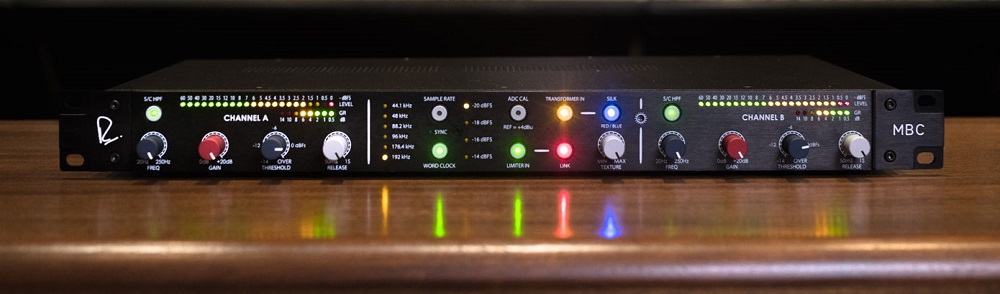
The middle third of the MBC’s front panel is divided into two sections. On the left side, you’ll find a stack of LEDs that indicate the selected sample rate—choose from 44.1, 48, 88.2, 96, 176.4, or 192 kHz. The MBC builds on the converter design found in the Rupert Neve Designs RMP-D8 8-Channel Dante Mic Pre.
The MBC can serve as a master word clock or synchronize to an external clock signal, using a pair of Word Clock In/Out BNC connectors on the rear panel. When the unit locks onto an incoming word clock signal, a green LED lights up, and a buffered clock signal is sent out through the word clock output BNC.
Next on the panel is a pushbutton that cycles through the MBC’s analog-to-digital converter (ADC) digital reference calibration settings. The options are -14 dBFS, -16 dBFS, -18 dBFS, and -20 dBFS, all referenced to a +4 dBu analog level or 1.228 volts (RMS).
Also in the middle section, you’ll find the Limiter In/Out and L/R link buttons, the transformer In/Out button, and the Silk transformer saturation mode toggle. Here, you have three choices for the sound of the two Rupert Neve Designs custom inter-stage transformers: Red Silk adds saturation to the high mid-range and high frequencies, Blue Silk enhances the low frequencies, or you can select the Off position for transformer-only coloration.
The Texture rotary control adjusts the amount of Silk when it’s engaged. The Silk effect is applied to both Channels A and B together and is highly dependent on the incoming analog levels. Below, you’ll find an image of the unit’s rear panel.
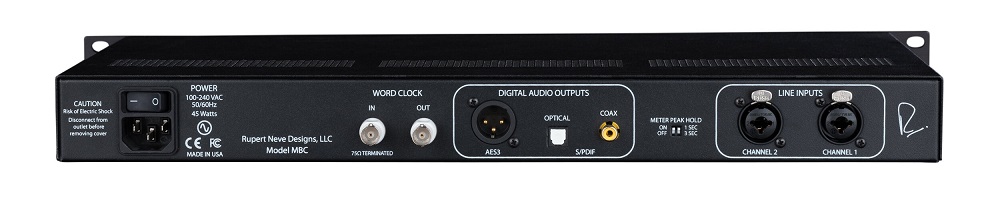
- Analogue line inputs: 2x balanced XLR/TRS combo
- Digital outputs: AES3 (XLR), S/PDIF (Optical and Coax)
- Word clock: BNC In (75Ω terminated) and Out
- Frequency Response (20Hz to 70kHz): ± 0.025% dB (transformerless path) or ± 0.1dB (transformer path)
- Noise (10Hz to 22kHz): -108dBFS (transformerless path) or -114dBFS (transformer path)
- Sample Rates: 44.kHz to 192kHz at 24 bit
- ADC Calibration (for +4dBu analogue): -14dBFS, -16dBFS, -18dBFS and -20dBFS
- Limiter Sidechain Filter: 12dB/oct Sallen-Key high-pass, 20Hz to 250Hz
- Limiter Time Constants: 500µS fixed attack, 50mS to 1S release
- Weight (shipping): 4.5kg
Why You Need the Rupert Neve Designs MBC
Whether you’re tracking, printing mixes, or mastering, the Master Buss Converter is a game-changer in high-quality and high-performance A-D conversion technology.
The analog drive circuitry allows the MBC’s converter to be fed by either a class-A transformerless path for maximum transparency or by custom interstage audio transformers with variable Silk, offering a wide range of tonal enhancements.
Paired with an astonishingly musical limiter, the MBC is always the best choice for capturing your analog signals with breathtaking, three-dimensional accuracy.
FREQUENTLY ASKED QUESTIONS
What Makes the Rupert Neve MBC Unique?
Rupert Neve MBC stands out because it merges classic analog warmth with modern flexibility.
We get the iconic Neve sound, but with a user interface designed for today’s workflows. The layout is intuitive, giving us precise control without sacrificing speed.
If we crave analog character and seamless digital usability, the MBC delivers a unique and innovative solution.
How Does the Rupert Neve MBC Sound in Real Sessions?
After exploring what sets the Rupert Neve MBC apart, let’s talk about how it actually performs in real sessions. When we patch it in, the analog warmth is immediately apparent—rich, yet never muddy.
We notice enhanced signal clarity even when pushing the dynamics, allowing every layer to shine. The MBC doesn’t just color the mix; it reveals nuance, depth, and a modern quality innovators crave.
Rupert Neve MBC vs. Other High-End Converters
Although the market offers several excellent high-end converters, the Rupert Neve MBC stands out with its unmistakable sonic character and flexible workflow.
When we compare it to other elite options, we notice the MBC’s exceptional ability to marry analog warmth with uncompromising sonic clarity.
This unique pairing inspires us to push creative boundaries, making the MBC a forward-thinking choice for those who crave innovation in their mastering chain.
Should You Invest in the Rupert Neve MBC?
Given the MBC’s clear sonic advantages over its competitors, we need to contemplate whether it justifies its premium investment.
If we’re chasing that elusive blend of vintage warmth and unmistakable analog character, the Rupert Neve MBC stands out as a compelling choice.
For those of us seeking to innovate while honoring classic tone, the MBC offers a unique balance that few modern converters can truly match.
Is the Rupert Neve MBC worth its high price?
When we consider the Rupert Neve MBC’s price tag, it’s natural to weigh its tangible benefits against the significant financial commitment. We’re not just paying for a name; we’re investing in a unit that fuses vintage warmth with modern clarity.
If we’re focused on achieving that rare blend in our productions, the MBC’s character and precision might justify its premium for true innovation seekers.
Why no direct computer or USB connection on the MBC?
While many modern processors offer USB or direct computer connectivity, the Rupert Neve MBC takes a different approach, staying true to its analog roots.
We notice the absence of digital integration and recognize this choice emphasizes uncompromising audio quality.
Connectivity limitations may seem restrictive, but by forgoing computer interfacing, the MBC prioritizes pure signal paths.
Why doesn’t the MBC have a front-panel mains switch?
Just as the MBC forgoes digital connectivity to maintain a pure analog signal, its lack of a front-panel mains switch reflects a similar design philosophy.
We see this as an intentional choice: minimizing potential points of interference and signal degradation.
Does the MBC’s limiter squash mixes too much?
Although some mastering limiters can flatten the life out of a mix, we’ve found the MBC’s limiter strikes an impressive balance between transparency and control. It lets us push levels without sacrificing analog warmth or compromising signal clarity.
Instead of squashing dynamics, the limiter preserves the essence of our mixes. For those seeking innovation and punch, the MBC’s limiter respects the music’s energy while maintaining sonic integrity.
Why does the MBC’s mix input sound different from DAW return?
Even when we route the same mix through the Rupert Neve MBC’s mix input and compare it to the DAW return, the sound isn’t identical.
The MBC injects analog warmth, subtly shaping transients, harmonics, and stereo image in ways a digital path can’t replicate.
While DAW return offers digital clarity, the MBC imparts a musical character that pushes us toward innovative, emotionally engaging sonic textures.
What is the difference between Neve and Rupert Neve Designs?
Curiously, many people wonder whether “Neve” and “Rupert Neve Designs” refer to the same company or philosophy. They’re actually distinct entities.
While classic Neve gear offers unmistakable vintage appeal, Rupert Neve Designs fuses that legendary sonic character with modern technology. We see RND as pushing boundaries—embracing the warmth of the past while delivering innovation that today’s producers and engineers crave. It’s the best of both worlds.
Who owns Rupert Neve Designs?
As of today, Yamaha Corporation owns Rupert Neve Designs, having acquired the company in 2021. Despite the ownership change, the brand continues to balance vintage appeal with modern integration, pushing boundaries in audio innovation.
We can trust that this legacy remains intact, with Yamaha supporting the pursuit of cutting-edge design while honoring Neve’s iconic roots.
What are Rupert Neve’s most famous designs?
While many audio engineers recognize the Neve name, Rupert Neve’s most famous designs have become industry standards for a reason.
We often point to the legendary 1073 preamp and 33609 compressor, known for their lush analog circuitry and signature warmth.
His use of vintage transformers defined the “Neve sound,” inspiring countless modern designs. These innovations continue to shape how we approach music production today.
Conclusion
Ready to upgrade your converters and add a unique twist to your sound? This is the unit you’ve been looking for. If you’re a serious engineer, the price won’t be an issue—you’ll appreciate the one-of-a-kind character it brings to your audio that no other unit can match.
If you have any questions about this unit, feel free to leave a comment below or visit Rupert Neve’s website for more information!